Enter Password
Designed an AI-powered writing feature that generated context-aware replies directly within HubSpot's customer support workspace, helping teams resolve tickets faster.
Role: Senior Product Designer I
Company: HubSpot
Timeline: Q1 2024
Overview
Background
Support teams are expected to deliver fast, high-quality responses while managing an increasing volume of customer conversations. To help reps work more efficiently without sacrificing response quality, HubSpot explored how AI could be embedded directly into the support workflow to assist with drafting responses.
The problem
Support reps were spending too much time manually crafting responses and gathering context across multiple systems, leading to slower resolutions and inconsistent customer experiences.
The opportunity
Enable support reps to resolve customer conversations faster and more consistently by generating context-aware response drafts directly within their workflow, reducing manual effort while keeping humans in control of the final response.
The solution
We designed an AI-powered response experience that analyzed customer conversations and knowledge sources and generated context-aware replies directly within HubSpot's Inbox and Help Desk. Reps could quickly review and/or edit before sending, enabling faster and more consistent responses without sacrificing control.
Process
Handoff from a different team
With the Reply Enablement mission transferred to our team, we had to quickly assess the existing design, identify opportunities, and determine the path forward.
Explorations
To address concerns with the inherited design, I quickly explored alternative directions for the Reply Recommendations alpha experience.
Alpha release and learnings
We released the alpha to five customers and quickly conducted research to understand where the experience was falling short.
Beta release
Before rolling the feature out more broadly, we incorporated alpha learnings to improve trust, transparency, and usability.
Handoff from a different team
This project started a little differently than most. Rather than defining the experience from scratch, we inherited the designs below and were asked to implement them immediately. The Reply Enablement team was shifting missions, and my team, Thread Experience, absorbed their work to become the newly formed all powerful Rep Messaging team.
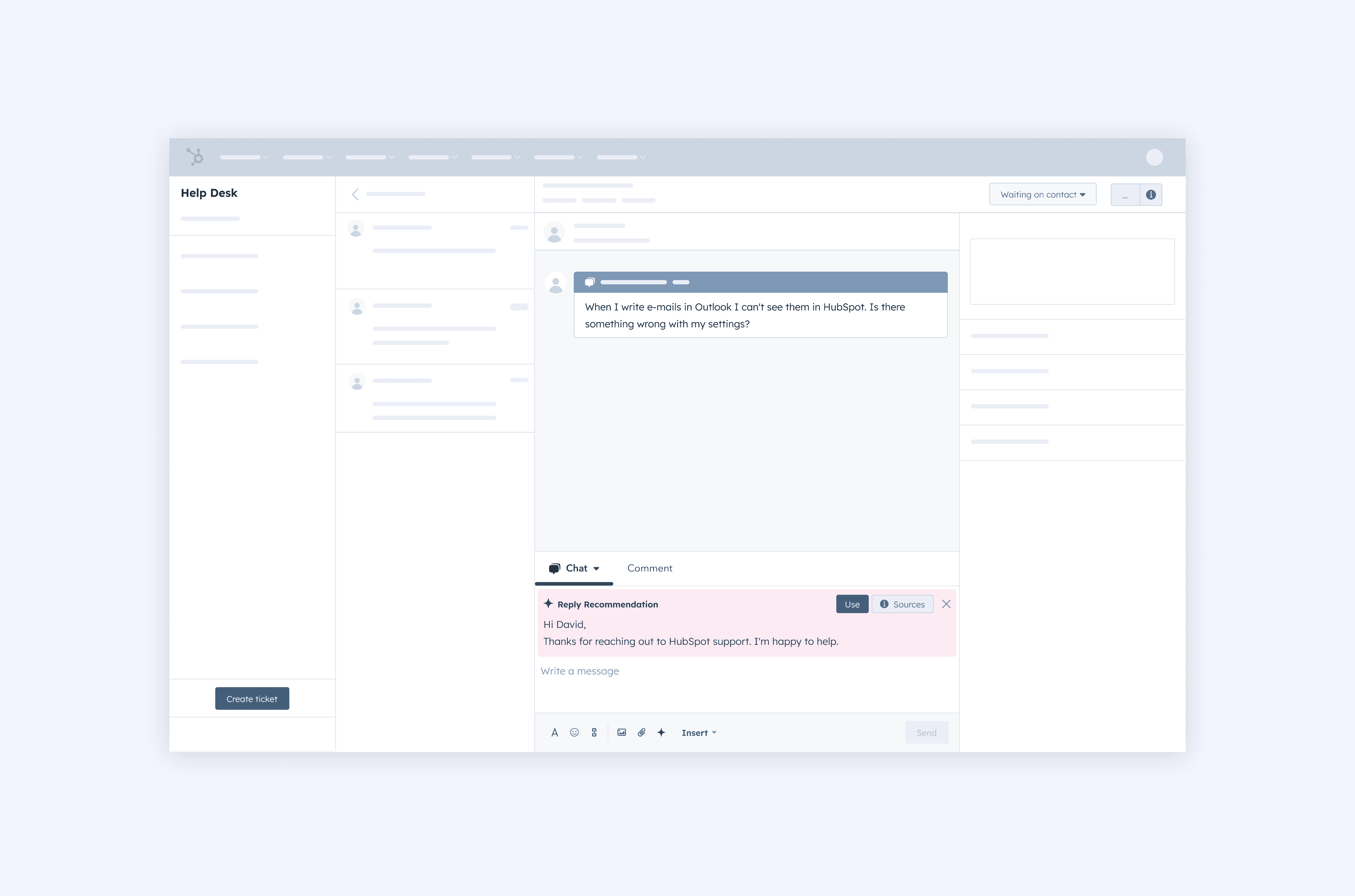
One of the biggest concerns with the initial design was how much of the reply editor was dedicated to the recommendation itself. Previous research had shown that reps already felt constrained by the amount of space available for composing messages. Giving a recommendation so much prominence created risk, of course when the suggestion was helpful it added value, but when it missed the mark it displaced the very workspace reps needed to do their job. I decided to push back against this deadline and quickly explore some other designs that would still surface the recommendation but preserve space for reps to review, edit, and compose their responses.
Explorations
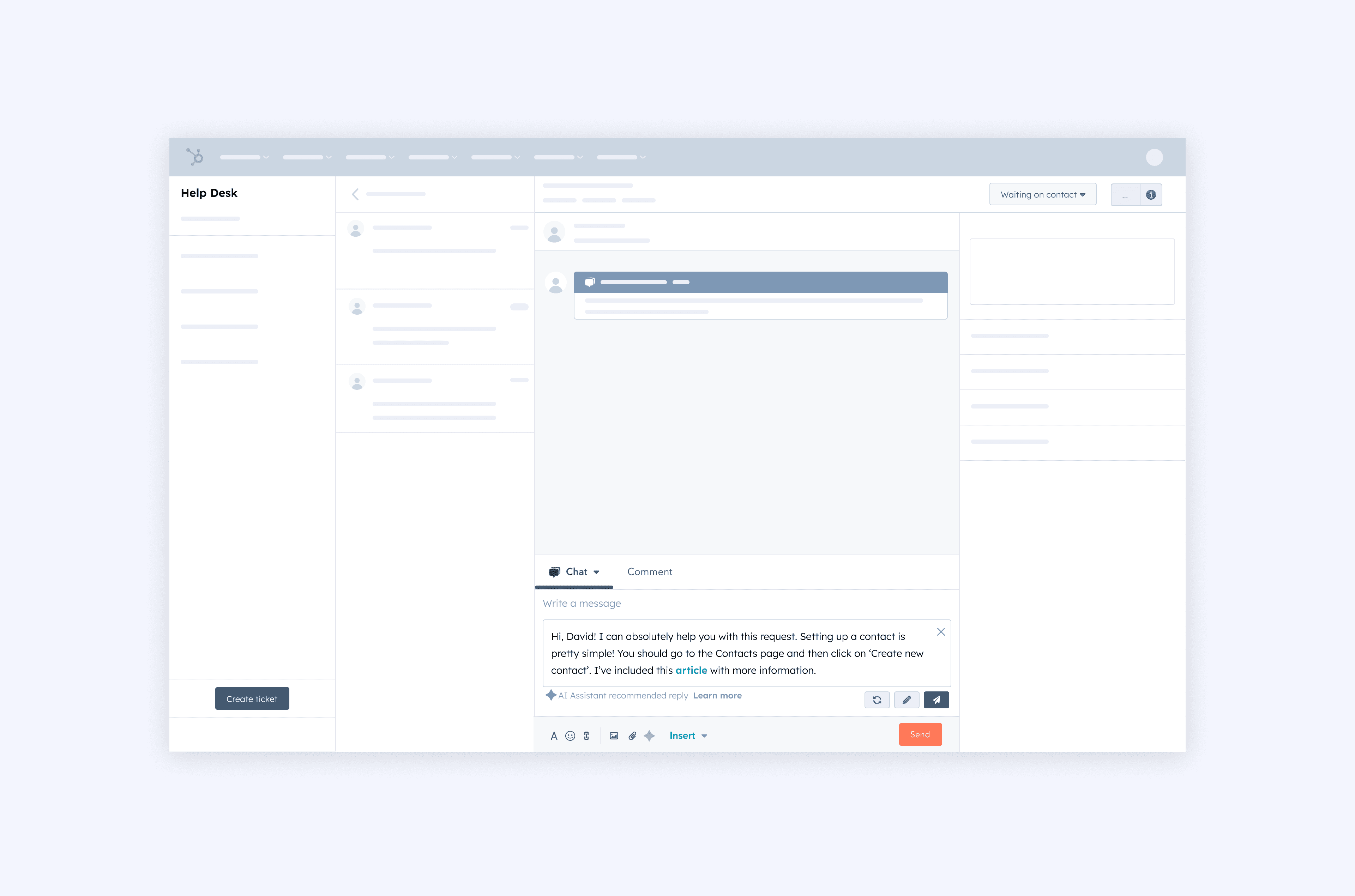
As the Help Desk team explored a new layout, I investigated several ways AI-generated reply recommendations could fit into the workflow. My early concepts used a floating modal above the reply editor, drawing on patterns I had previously explored when designing HubSpot's AI writing tools.
My other explorations tested a number of ideas, including generating multiple reply variations at once and surfacing recommendations directly within the conversation thread. While the thread-based approach provided more space, it quickly became cluttered when multiple suggestions were present and could potentially confuse users on what messages had already been sent. These concepts helped us better understand the tradeoffs between visibility, usability, and complexity as we refined the alpha experience.


Alpha release and research learnings
While my explorations were well received, time constraints and engineering complexity limited what could be included in the alpha release. The design below focused on improving the areas with the highest impact: reducing the visual footprint of recommendations, refining the controls, and aligning the interface with HubSpot's broader AI design language.
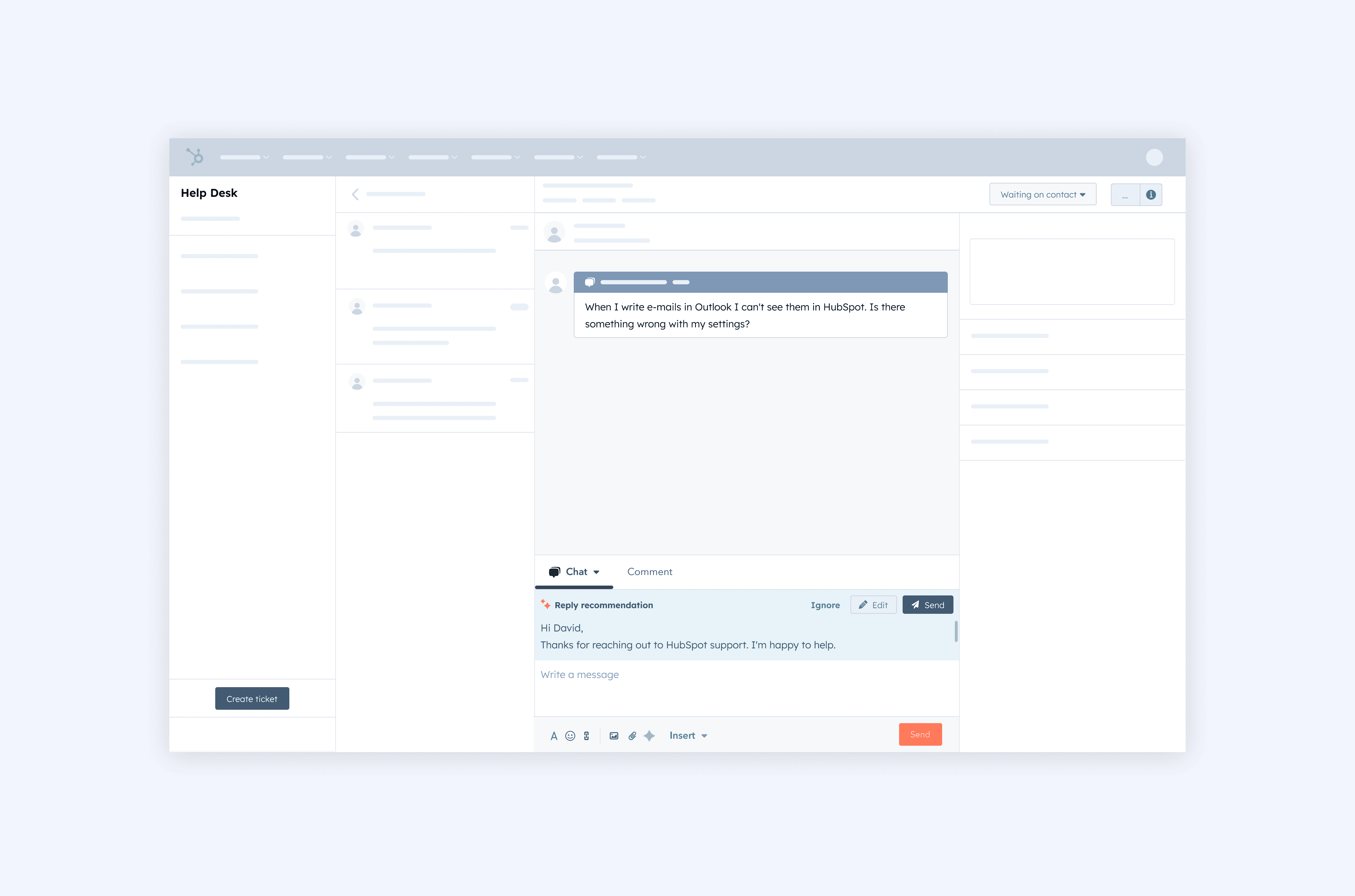
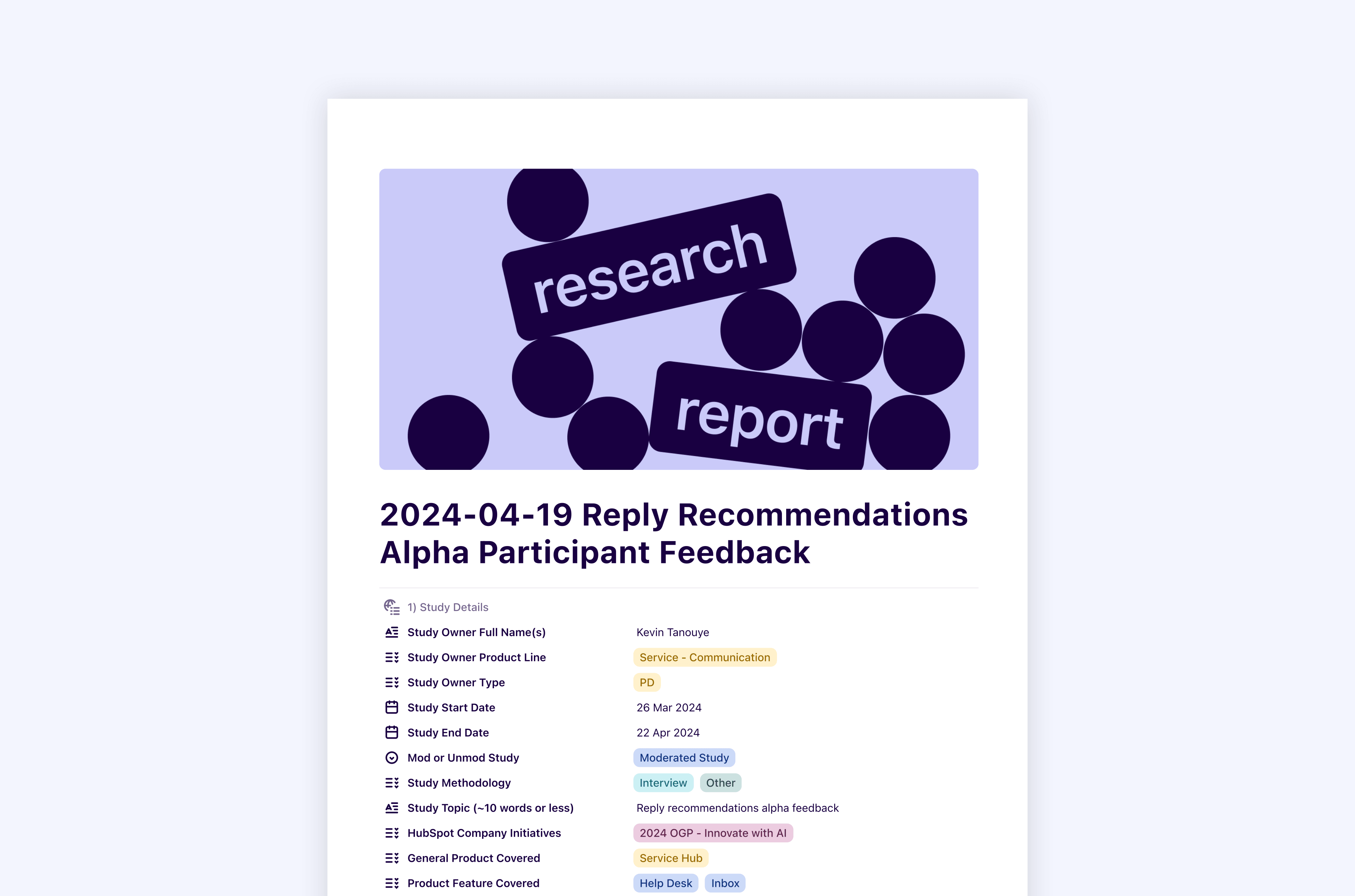
We quickly conducted user research with our 5 alpha participants. Research showed that recommendation quality and trust were the biggest challenges facing adoption. Participants often questioned the accuracy of suggestions and wanted more visibility into the sources behind recommendations. They also expected responses to feel more personalized and better grounded in previous conversations, highlighting opportunities to improve transparency, contextual awareness, and overall recommendation quality.
Beta release
Following our alpha release, we revisited the experience using research findings and customer feedback before expanding access in beta. This phase also gave us an opportunity to address many of the edge cases we had intentionally deferred to move quickly during alpha.
One of the most notable changes was replacing the "Send" button with "Use." Research showed that users wanted an opportunity to review and edit AI-generated responses before sending them to customers, making "Send" feel too final and potentially risky.
We also introduced source transparency, allowing users to view the knowledge sources that informed each recommendation. This helped build trust in the AI's output and gave users more context when evaluating response quality. Finally, we updated the visual design to align with HubSpot's evolving AI identity, incorporating the new magenta gradient styling across the experience.
Edge cases and settings
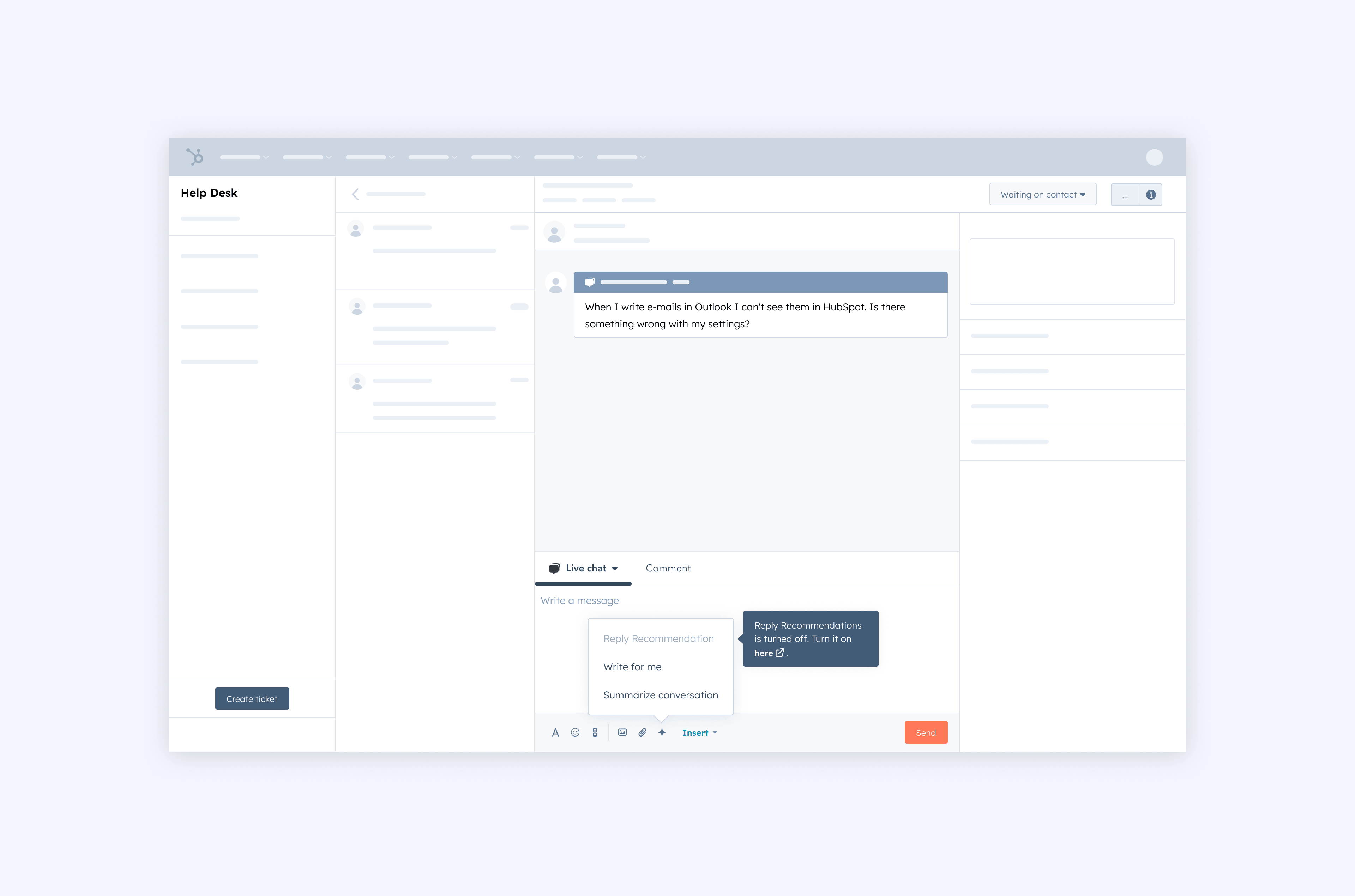
As we prepared for beta, we worked through the many edge cases involved in generating and accessing reply recommendations. We also finalized the settings experience, ensuring users could easily discover, configure, and understand the feature regardless of their permissions or account setup.


Outcomes
Reply Recommendations became part of HubSpot's broader AI-powered customer support experience, helping reps draft responses more efficiently within Inbox and Help Desk. The feature contributed to HubSpot's Breeze Customer Agent platform, which served more than 8,000 users and helped drive a 39% reduction in resolution time.
Conclusion
Reply Recommendations reinforced a lesson that has shaped much of my AI design work: generating an answer is only part of the problem. Users also need enough context, transparency, and control to trust that answer. Many of the most impactful decisions, from reducing the recommendation's visual footprint to exposing sources and changing "Send" to "Use," were not about improving the AI itself, but about helping users confidently evaluate and refine its output. These learnings later informed my work on HubSpot's AI agent experiences, where trust and transparency became even more critical.
© 2026 Kevin Tanouye